
Positions and Triads Reference
Table of Contents
How to Use This Reference
The creative sequence described on the Framework page isn’t abstract theory. Each of the nine positions carries a specific quality visible through the words that share its resonance. This reference explores each position through the words themselves, what they reveal about each stage, and how the three triads organize the complete creative process.
These are references, not definitions. The richness lives in the relationships between words sharing the same position, relationships that circular definitions will never reveal.
THE GENERATIVE TRIAD: THE PROJECTOR SIDE (Positions 1-3)
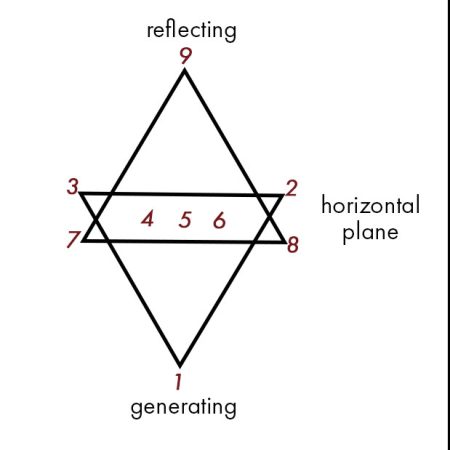
This is the generative side. The beginning of a new cycle. The projector conceiving, focusing, and directing. Everything that unfolds through experience and reflection begins here, whether you’re aware of it or not.
Position 1: Idea
Everything starts with an idea. Before anything manifests, before consciousness even recognizes it, there must first be the idea itself. “Idea” (6-4-1) carries a numeric value of 1, the generative source.
What makes this position revealing is what else sits here. “Attention” (3-7-1), “human participation” (3-7-1), and “engagement field” (3-7-1) all share the same resonance. These aren’t separate concepts that happen to overlap. They describe the same function from different vantage points: the point where creation begins compression.
You don’t direct attention toward ideas. You ARE the attentional field where ideas organize.
“Past memory” (1-9-1), “feel” (1-9-1), and “embodied cognition” (1-9-1) also share this position.
Memory isn’t dead content stored in your past. It sits in the same landscape as feel. It’s generative material, an idea ready to unfold. Not asking to be analyzed. Asking to be felt.
When this position flows naturally, it expresses as generating, aligning, individuate. When over-modulated, it can manifest as rigid control or forced implementation. When under-modulated, it appears as need without coherent structure.
Understanding Position 1 shifts your relationship with creativity from production to revelation, from making something new to allowing the expression of what’s already present in the generative field.
Position 2: Conceiving
Once idea exists, we enter the mode of conceiving. This is where the idea begins to take form, not through the senses, not from outside, but from the generative field itself, recognizing what’s possible. “Conceiving” (2-9-2) carries a numeric value of 2, along with “creative” (2-9-2), “created” (2-9-2), and even the phrase “centering seed” (2-9-2). They all share the exact same numeric pattern.
Think of this position as germination. The seed has cracked open but hasn’t broken through the soil yet.
“Perceive” also has a numeric value of 2, but there’s an important distinction worth understanding. Conceiving is generative; it comes from within the creative field. Perceiving comes through the senses, from outside. A TV commercial can make you perceive an idea that was never yours. Conceiving is the idea stirring from your own generative source. Same position in the sequence, but the orientation is completely different.
“Light” (9-2-2) and “creative expression” (9-2-2) also share this position. Russell described light not as visible illumination but as the fundamental process of creation itself. Converting the word to numbers shows where that process sits, at the generative source alongside conceiving. Light IS conceiving. The generative side IS creative expression.
“Vibration” (7-4-2) and “balance” (7-4-2) share the same resonance pattern at Position 2, revealing that the germination phase fundamentally involves balanced, rhythmic movement between complementary states.
“Context” (2-9-2) and “manifestation of desire” (2-9-2) also sit here, showing how this position contains all possibility in seed form before it enters the experiential field.
When flowing naturally, Position 2 expresses as self-alignment and creative expression. When over-modulated, it manifests as projected thinking, exploitation, or excessive control. When under-modulated, it appears as free-floating attention or insufficient coherence.
Position 3: Intention
With idea and context established, energy organizes into creative focus. “Intention” (2-1-3), “motivation” (4-8-3), and “birth” (9-3-3) all share Position 3. This is where excitement builds, where the creative process is born into active potential.
Here’s where the projector analogy becomes visible in the numbers themselves.
“Human” (4-8-3) and “projector” (8-4-3) both sit at Position 3. So does “gravity” (8-4-3). You, as human, are the gravitational focal point that compresses light into specific experience. The projector. The lens through which potential takes direction.
“Organizing” (7-5-3) and “freedom” (7-5-3) share the same resonance. This is one of the practical significant discoveries in Word Cosmology.
Balanced organizing literally IS freedom. Not metaphorically. When organizing happens from alignment rather than forced control, the experience IS freedom.
“Allowing” (7-5-3) also shares this pattern. The active form of allow sits with freedom and organizing at the human focal point.
When flowing naturally, Position 3 expresses as clear intention and organized momentum, which we experience as “peace” (2-1-3). When over-modulated, it manifests as systems of external control. When under-modulated, it appears as scattered energy without coherent direction.
THE EXPERIENTIAL TRIAD: THE THRESHOLD (Positions 4-5-6)
Here the projection crosses from potential into lived experience. The idea enters awareness, becomes tangible, and crystallizes into form. This triad represents the horizontal plane where experience manifests.
Position 5 serves as a unique mathematical zero point (55 × 99 = 5445, where the number mirrors itself and the difference is zero), marking the threshold where balance poles coincide, creating perfect equilibrium.
Desire (1-5-6) forms a bridge from the generative source through the experiential threshold to manifestation, revealing desire not as “wanting what you don’t have” but as the natural pathway through which ideas express into form.
Position 4: Consciousness
At the fourth stage, the idea begins to recognize itself. “Consciousness” (2-2-4) carries a numeric value of 4. Just as a baby gazes at its own hands in wonder, consciousness is where the creative process develops self-recognition.
This is where your creative project seems to take on a life of its own, revealing aspects you hadn’t consciously planned. The idea is no longer just something you’re working on. It’s becoming something with its own presence.
“Creation” (3-1-4), “realize” (2-2-4), and “presence” (6-7-4) share this position. “Mind” and “cause” both (9-4-4) are also at Position 4, providing a reframe of mind beyond cognitive interpretations. The “default network” (2-2-4) shares this resonance, with balanced expressions including “fearless,” “innocent,” and “belonging,” qualities of consciousness functioning without distortion.
This positioning challenges conventional understanding. Rather than being a fundamental force that precedes and creates reality, consciousness emerges as a participant in the creative process specifically at Position 4, after the generative principles have already established directional movement.
When flowing naturally, Position 4 expresses as clear presence without excessive analysis. When over-modulated, it manifests as rigid categorization or conceptual fixation. When under-modulated, it appears as vague awareness without sufficient clarity.
Position 5: Experience
“Experience” (2-3-5) carries a numeric value of 5, the experiential threshold where idea becomes individuated through direct engagement. No longer conceptual but tangible. The business isn’t just a plan, it’s operating. The book isn’t just an outline, it’s being written.
“Life” (5-9-5), “feedback loop” (5-9-5), “creating” (6-8-5), “surrender” (4-1-5), and “language” (1-4-5) share this position.
“Surrender” here surprised me when I first saw it. But it makes sense. This is the point where you’re either fighting to control the unfolding or you’re surrendered to being the field where it happens. Surrender isn’t giving up. It’s fully being the experience rather than narrating it from outside.
“Language” at Position 5 shows that language functions as the experiential field itself where ideas become experientially real, not as a tool applied to experience from outside.
“Recursion” (5-9-5) and “life” sharing this position reveals that life itself is recursive, a feedback loop at the experiential threshold where potential becomes actual.
When flowing naturally, Position 5 expresses as direct experience and alignment with being. When over-modulated, it manifests as overwhelming intensity. When under-modulated, it appears as disconnection from direct experience.
Position 6: Believe
Once we’ve experienced an idea, belief naturally follows. “Believe” (6-9-6) carries a numeric value of 6, representing the crystallization of experience into something we hold as true.
This is why changing beliefs is so challenging. They aren’t thoughts you can replace with better thoughts. They’re crystallized experiences that formed through the entire sequence from idea through experience. Trying to change a belief by arguing with it is trying to undo crystallization at the surface while the structure beneath remains intact.
“Manifest” (6-9-6) also occupies Position 6, revealing this position as the destination toward which all creative expression naturally flows. Mathematical grid analysis confirms this: every direction in the grid sums to 6. All paths lead to manifestation.
“Word” (6-9-6) and “indicative” (6-9-6) share this exact same pattern. The word itself, the basic unit of language, sits at the manifestation constant. And indicative, the grammatical mood that states what IS, sits right beside it. Words don’t just describe what has manifested. They ARE manifestation. The language you use is crystallized experience, indicative of what has formed through the complete creative sequence.
“Self” (5-1-6) and “the” (5-1-6) share this position. The definite article carries individualizing energy. “Awareness” (3-3-6) culminates here, representing the conscious recognition of what is manifesting.
When flowing naturally, Position 6 expresses as natural manifestation and coherent form. When over-modulated, it manifests as rigid structure or crystallized identity. When under-modulated, it appears as formlessness or difficulty bringing concepts into tangible form.
THE REFLECTIVE TRIAD: THE SCREEN SIDE (Positions 7-8-9)
This is the screen. Reflected light. Where everything becomes visible, integrates, and completes. These positions describe the recognition side of the creative process, where experience integrates, patterns record, and the cycle prepares to begin again.
This triad represents the field of integration, information, and resonance. Space (6-2-8) serves as the hosting field where reflection (7-1-8) occurs. The triad culminates with energetic harmonic resonance, completing the cycle while preparing for renewal.
Position 7: Identity
At Position 7, the idea becomes integrated into who we are. It’s no longer separate but part of our self-definition. “Identity” (3-4-7) carries a numeric value of 7, sharing this position with “create” (2-5-7) and “choice” (2-5-7).
“Create” at Position 7 reveals that what we conventionally call creating actually functions reflectively, as selection among existing patterns. It resonates with “choice” because that’s what it is, choosing from what’s already reflected. This explains why “trying to create” often involves struggle. You’re attempting to originate from a reflective position.
Meanwhile, “creating” (6-8-5) sits at Position 5 in the experiential phase. While “create” is reflective selection, “creating” is active engagement. The language itself carries this distinction in its grammar.
“Fractal” (2-5-7) shares the same pattern as “create,” illuminating the fractal nature of this position, self-similar patterns reflecting the whole within individuated parts.
“Form” (6-1-7), “be” (5-2-7), and “listen” (5-2-7) also share this position. “Being” (5-5-1) sits at Position 1 while “be” sits at Position 7. Same word root. Two positions. Two directions. The active process of idea becoming form, and the recognition of what already is.
“Manage” (7-7-5) and “explore” (7-7-5) share the same resonance, though at Position 5. This reveals that when managing flows from curiosity rather than anxiety, it IS exploration.
When flowing naturally, Position 7 expresses as clear discernment and integrated choice. When over-modulated, it manifests as effort, willpower, dark obsession, trying to get. When under-modulated, it appears as blocked expression or inability to recognize distinct patterns.
Position 8: Reflected Light
Position 8 is the screen itself. The hosting field where everything becomes visible.
“Reflected light” (6-2-8), “God” (6-2-8), “space” (6-2-8), and “operating system” (6-2-8) share the same resonance. The screen where everything becomes visible, what humanity has sought as the highest reality, carries the same numeric signature as reflected light and space.
“Reflection” (7-1-8) and “action” (7-1-8) share the exact same pattern. Action and reflection aren’t separate processes. They’re the same resonance expressing through different aspects. This is effortless action, where action emerges naturally from clear reflection.
“Information” (4-4-8) also resonates here, along with “field of experience” and “creation matrix,” showing that information functions as the space where reality patterns appear to awareness, not content we collect.
“Two way” (5-3-8) and “polarity” (5-3-8) reveal that Position 8 IS two-way motion itself, embodying the polar relationships that Russell identified as fundamental to creation.
“Jesus” (8-3-2) and “energy” (8-3-2) share Position 2, the active projecting force sitting directly across from God at the screen. “The Father and I are one” isn’t two beings in agreement. It’s the projector and the screen. Two aspects of the same system.
When flowing naturally, Position 8 expresses as equanimity, effortless being, alignment with the mirror quality of space. When over-modulated, it manifests as projected thinking, imposing frameworks onto the reflective field. When under-modulated, it appears as anxiety, an inability to hold the tension of opposites.
Position 9: Love
Position 9 is where patterns complete, integrate, and return to source while simultaneously seeding new creation.
” Love” (2-7-9), “record” (2-7-9), “magnetic field” (2-7-9), and “telepathic” (2-7-9) share the same resonance. Love at Position 9 isn’t the romantic love of greeting cards. It’s the magnetic field that harmonizes all creation and maintains the record of all that has manifested. And it’s telepathic, operating beyond the senses, the connective resonance you feel before words can name it.
“Free energy” (9-9-9), “thought” (9-9-9), and “self-recursive” (9-9-9) share the same 9-9-9 pattern. This is the phase where energy cycles freely without depletion.
“Expression” (7-2-9), “inspiration” (7-2-9), and “allow” (7-2-9) share Position 9. Expression IS inspiration. And “allowing” (7-5-3), the active form, sits with freedom at Position 3. The two directions operating simultaneously.
“Manifesting” (6-3-9) extends to Position 9, showing how this position relates to the cycling energy that sustains ongoing creation. While “manifest” occurs at Position 6, “manifesting” extends to Position 9 as the free energy sustaining the process.
“Reality” (4-5-9) carries a pattern spanning the experiential triad through the reflective triad, beginning at Position 4, moving through Position 5, culminating at Position 9. What we experience as reality functions as a reflection, a self-recognition. Reality is the self recognizing itself, the projector seeing its own movie.
When flowing naturally, Position 9 expresses as harmonious resonance and effortless cycling. When over-modulated, it manifests as chaotic energy or excessive recycling without fresh input. When under-modulated, it appears as depleted energy or disconnection from the cycling that sustains the creative process.
THE GRAMMATICAL PATTERN
One of the most consistent patterns across word families is that grammatical form tracks with position in the creative sequence.
Active and participial forms (being, listening, creating, allowing) tend to land generative or experiential, Positions 1-5. Root and noun forms (be, listen, create, allow) tend to land reflective, Positions 7-9.
“Being” (5-5-1) at Position 1 is the active process of idea becoming form. “Be” (5-2-7) at Position 7 is recognizing you already are. “Creating” (6-8-5) at Position 5 is active engagement. “Create” (2-5-7) at Position 7 is reflective selection. “Allowing” (7-5-3) at Position 3 is freedom at the human focal point. “Allow” (7-2-9) at Position 9 is expression and inspiration.
The language itself is structured as a two-directional system. Active engagement forms land where the projector operates. Abstract and conceptual forms land where the screen reflects.
THE UNIFIED CREATIVE SEQUENCE
The three triads aren’t separate regions. They’re unified aspects of one creative process. Generation flows into experience, which integrates through reflection, which seeds new generation.
Idea emerges (1). It organizes as potential (2). Intention activates (3). Consciousness develops (4). Experience happens (5). Belief crystallizes (6). Identity integrates (7). Reflection occurs (8). The pattern records, completes, and cycles (9).
This sequence operates whether you’re aware of it or not. The difference is whether you’re resisting the motion of unfolding by trying to control it from the screen, or whether you’re surrendered to being the focal point where the idea unfolds.
The activities don’t stop. The quality transforms from effort to flow. From forced control to aligned exploration. From creating stories about your experience to being the experience itself.
Explore the patterns at WordCosmology.com. Convert words that matter to you. See what other words share their resonance. Let the relationships speak.