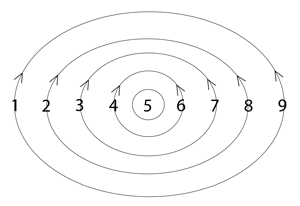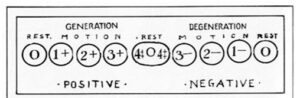
desire
1-5-6
Conventional Understanding
We typically think of desire as wanting something we don’t have. Dictionary definitions frame it as longing or craving, positioning desire as a gap between current reality and preferred outcomes. This understanding shapes entire industries – from advertising that manufactures lack to self-help systems promising techniques to ‘manifest your desires.’
We’re taught to manage desire, channel it productively, or transcend it through spiritual practice. The conventional view treats desire as a psychological state that motivates action toward external fulfillment.
Resonant Understanding
When we convert “desire” to numbers, we find a 1-5-6 pattern. This same pattern appears in “the creative force self-perpetuating,” “alignment with creative force,” and “artist.”
What does this tell us? Desire isn’t longing for what you lack. It’s the creative force itself moving through you. You don’t have desires separate from yourself – you ARE desire expressing as form.
Think of it like a river. The river doesn’t flow toward something – it IS the flowing. Same with desire. Most people exhaust themselves chasing what they think they want, only to discover their true longing points elsewhere. That’s because they’re operating from thoughts ABOUT desire rather than flowing AS desire itself.
The difference is everything. One is exhausting pursuit. The other is natural expression.
Expressions Spectrum Analysis
Balanced expressions include “the creative force self-perpetuating,” “alignment with creative force,” “experiencing my idea,” and “I surrender to my magnetic field.” These show desire as natural creative flow. “Eye of the hurricane” reveals the still center where desire expresses without distortion.
Over-modulated expressions like “creative force compulsion,” “hijack,” “follow my will,” and “matrix thinking” show desire distorted through attempts at control. “Planning,” “procedure,” and “task” reveal the rigid structuring that happens when people try to manufacture desire from thought rather than flow with it. “War” and “power struggle” demonstrate the aggressive patterns when desire becomes something to dominate.
Under-modulated expressions such as “no creative force,” “I do not feel real,” “helpless,” and “self-suppression” show what happens when desire disconnects from its source. “Distant,” “deceiving,” and “not wanting to be seen” reveal desire so suppressed it reverses into hiding.
Russell’s Cosmogony Connection
Walter Russell describes desire as the fundamental creative force of the universe. In “A New Concept of the Universe,” he states: “The only energy in the universe is the pulsing desire of Mind for the creative expression of Mind-knowing.”
Russell reveals that desire isn’t something separate from what you are but the very mechanism through which universal creativity individuates. Think of breathing – not acquiring air you lack but the pulsing expression of life itself. Similarly, desire functions as the universal heartbeat of creation expressing through you, not as deficiency seeking remedy.
Practical Implications
This understanding transforms how we relate to desire. Rather than managing cravings or manifesting wants, we recognize when we’re flowing AS desire versus operating from thoughts ABOUT what to desire.
Here’s the crucial distinction: thought (9-9-9) equals “a memory” (9-9-9). Most people mistake recorded thoughts for desire, attempting to recreate past satisfactions or fulfill programmed expectations rather than expressing fresh creative impulse.
When someone says “I desire this career” or “I desire that relationship,” they’re often replaying recorded patterns, trying to control manifestation from reflections of what worked before.
The attention extraction economy harvests this distortion brilliantly. By presenting manufactured desires through media and advertising, it redirects the fundamental creative force itself toward consumption and control.
People exhaust themselves pursuing what they think they desire, never recognizing they’re chasing memories rather than flowing with the generative force they actually are.
Instead of asking “What do I desire?” (positioning desire as external objective), we might ask “What flows naturally when I stop operating from thoughts about what I should want?”
The real power appears in recognizing that you don’t need to acquire desire or transcend it. You ARE desire expressing through form. By understanding this, we transform from exhausted strivers pursuing manufactured desires to conscious participants in the universal creative force expressing through us.