pay attention
2-5-7
Conventional Understanding
We use “pay attention” constantly without questioning what it means. Teachers command it, employers expect it, productivity experts optimize for it. The phrase itself reveals an unexamined assumption: attention must be paid, like a debt we owe to whatever demands our focus.
This creates a culture where attention becomes transactional. We believe we must gather it, direct it, sustain it through mental force. The phrase “pay attention” feels so natural we rarely notice it positions attention as currency to be spent, a limited resource requiring careful allocation.
Resonant Understanding
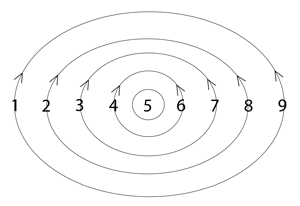
Converting language to numbers reveals “pay attention” carrying a 2-5-7 resonance pattern, sharing this numeric signature with “create,” “excellence,” “evolving,” “wonder,” and “focused human intention.” This exposes something remarkable: the phrase we use to command attention sits at Position 7 in the reflective triad, while attention itself (3-7-1) functions at Position 1 as the generative source.
“Pay attention” operates from the reflection side of creation, attempting to control what naturally flows from the generative field. It’s like standing at the end of a river trying to direct the water’s flow upstream. We’re trying to direct from Position 7 (reflection/recording) what naturally functions at Position 1 (generative source).
This reveals the mechanism through which we’ve collectively lived disconnected from our natural creative capacity, making life feel like struggle.
Expressions Spectrum Analysis
In balanced expression, this pattern appears as “alignment with life,” “engaged,” “evolving,” “feel desire,” “expansive,” “I can be me,” “I have enough,” “wonder,” “focused human intention,” “excellence,” and “be real.” Think of a child completely absorbed in play, where attention flows effortlessly. That quality of natural engagement reveals this pattern in balance.
When over-modulated, expressions include “pay attention,” “artificial,” “hostile,” “penalize,” “mental life,” “obsession,” “survival of the fittest,” “thinking power,” “will power,” and “egotism.” This is how we’ve predominantly experienced this pattern collectively—living from forced control and aggressive direction. The same frequency as “excellence” and “wonder,” but expressed through the wavelength of struggle.
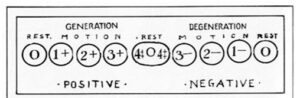
Under-modulated expressions like “behave,” “owe,” “self-conscious,” “vacant,” “irrelevant,” “negate,” and “blocked” show the collapse that happens when we can no longer maintain the over-modulated state. Like a pendulum swinging between forcing and giving up.
Russell’s Cosmogony Connection
Walter Russell describes how creation unfolds through desire expressing itself into form. In “The Universal One,” he writes: “Inertia cannot be overcome, nor motion take place, without the concentrative desire force of the creative, image making faculty of Mind.”
This illuminates why “pay attention” creates struggle. When we force concentration through will power rather than allowing focus to emerge from natural desire, we’re working against the fundamental creative process. The balanced expressions show alignment with desire’s natural concentrative force, while over-modulated expressions reveal resistance to this flow.
Russell states: “Concentrative thinking focuses idea into patterned form in seed of matter to manifest the fatherhood of Creation.” This describes the natural concentrative process that “focused human intention” represents, distinguished from the forced compression that “pay attention” attempts to impose.
Practical Implications
The challenge is that “pay attention” feels right because it shares resonance with genuinely balanced expressions like “excellence” and “wonder.” They’re all the same frequency, just different wavelengths. This is why the attention extraction economy operates so effectively. By using phrases that resonate at the same frequency as balanced creative expression, the control mechanism becomes nearly invisible.
When we tell children to “pay attention,” we’re not teaching them to access their natural capacity for “focused human intention.” We’re training them into the over-modulated wavelength that makes engagement feel like work, focus feel like discipline, learning feel like obligation.
Converting language to numbers reveals options invisible within linguistic circularity. We’ve collectively been living from over-modulated expressions, making life feel like struggle, without knowing balanced alternatives exist on the same frequency. The revelation isn’t about rejecting attention or focus. It’s recognizing we can engage this same 2-5-7 creative pattern from “alignment with life” and “wonder” rather than “will power” and “obsession.”
What shifts when we recognize the difference between attention (3-7-1) functioning at Position 1 as the generative field, and “pay attention” (2-5-7) operating at Position 7 trying to control from the reflective side?
We stop attempting to manufacture through effort what flows naturally from alignment. Instead of commanding ourselves to “pay attention,” we cultivate conditions where “focused human intention” emerges organically, where “wonder” and “excellence” express naturally through engagement with what genuinely calls to us.
This doesn’t mean abandoning discipline. It means recognizing that what we’ve called discipline often represents over-modulation of a creative capacity that functions best when aligned with its source rather than forced from its reflection.
Walter Russell’s quotes are from his book, “A New Concept of the Universe”.